
Structuring peer knowledge flow in online university spaces
When physical labs became inaccessible due to COVID-19 and infrastructure issues, informal student-to-student knowledge exchange disappeared.
Supervised Online Labs recreate departmental lab culture inside a structured online environment using Gather.town.
Audience
International Christian University Graduate students
Overview
Tools Used
-
Gather.town
-
University login authentication
-
Avatar Based Proximity video-system

Problem
At International Christian University (ICU), following the outbreak of COVID19 classes moved entirely online. During online instruction, students lost access to informal conversations that normally clarify degree requirements, funding opportunities, and departmental procedures.
Although official information was available on the ICU website, interpreting course requirement tables and academic terminology was difficult for new students. Terms that appeared on paper often required peer explanation, especially for students from other universities
Without shared physical space, there was no system ensuring that this peer knowledge circulated.
Solution
To address this, I designed supervised online labs by:
-
Recreating lab spaces as explorable 2D environments in Gather.town
-
Assigning experienced students as paid lab supervisors
-
Organizing bi-weekly facilitated discussion sessions
-
Offering walk-in one-on-one support hours
The goal was not to replicate classroom teaching, but to formalize peer expertise and stabilize information flow.

Post-it listing issues clustered into thematic groups

Moving from clustering into mind map highlighted the solution: the Senpais (top right)
The process
Reframing the problem through affinity mapping, I reorganized the initial post-its generated during class brainstorming into thematic clusters. By grouping related issues and examining recurring patterns, three core concerns emerged:
-
System complexity
-
Lack of socialization in online mode
-
Difficulty interpreting institutional information
-
This restructuring clarified the problem space and made visible the areas the design would need to address:
-
Lacks of reliable knowledge about degree requirements
-
Lacks of reliable knowledge about funding
The key question became: WHO already holds this knowledge?
Second-year MA and PhD students emerged as distributed knowledge carriers.
This realization led to the creation of a new position the "lab supervisor"
Creating a unique community of inquiry
The design draws from Community of Inquiry theory. The Gather.town environment supports social presence by recreating a shared space for interaction, while students’ enrolled in the same program enables cognitive presence through shared concerns and academic contexts. The supervisor role enacts teaching presence by structuring and facilitating dialogue, ensuring through lab meetings that discussions on a set number of topics remain focused and productive rather than incidental.

Garrison et al. (2000)

Own visualization of the community of inquiry i was envisioning using Demon Blade toys, a whiteboard, and a penguin
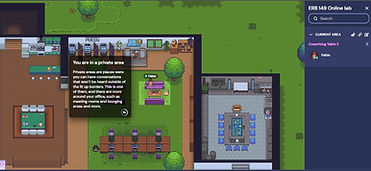
Creating the actual online space
The Gather.town space was designed to replicate the informal dynamics of a physical lab while remaining simple to navigate. I structured the environment into distinct areas, including a spawn point, open social zones, and a dedicated discussion room for scheduled meetings. The layout was intentionally minimal to avoid cognitive overload, while proximity-based video ensured that interaction felt spatial rather than grid-like. By organizing the environment around movement, visibility, and intentional gathering points, the space supports both spontaneous encounters and structured facilitation.


Takeaways
-
Structure. When physical proximity disappears, informal peer support does not automatically reconstitute itself online. It requires explicit roles and scheduled moments to sustain interaction.
-
Facilitation. Peer-led spaces can easily drift into silence or unstructured conversation; facilitation proved necessary to maintain focus without turning meetings into lectures.
-
Clarity. Institutional information is often available but difficult to interpret. The issue was less access and more translation.
-
Transferability. While the online environment responded to pandemic constraints, the supervisor role emerged as the most durable component and could operate independently of the digital platform.
Contact
I'm always looking for new and exciting opportunities. Let's connect.